
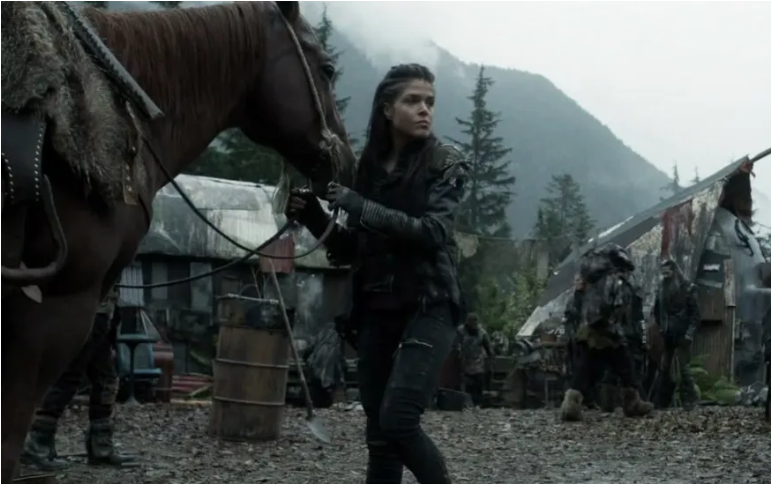
At the very first sight, Octavia Blake was like a person who was trying to identify themselves and not one who was heading to a state of being chaotic. Her initial moves were not strategic but reactive and frequently not motivated by anger but curiosity. When the discussion of Octavia Blake: Road to Destruction comes, people often forget how ordinary she appeared in the beginning. No apparent indication existed that she would become such a force in the future. It is that gradual transition that makes her arc seem natural rather than abrupt.
Survival conditions shaped her mindset quickly.
The world of the 100 does not give a chance to gradual individual development; everything accelerates during the strain. Examining Octavia Blake: Road To Destruction, one can trace how she had to adapt quickly because of survival situations. She was taught how to fight, lead, and make decisions without any hesitation. They were not changed by choice; they had to change to survive. In the course of time, the survival instincts completely replaced previous emotional responses.
Violence became a normal response, not a last option.
Another evident fact in Octavia Blake: Road to Destruction is that violence ceases to be a big choice. It becomes a reflex response to most cases. This transformation is not accomplished in one episode, but it is accumulated through episodes. After violence is normalized, it is more difficult to pull out of it. That trend illustrates the behavioral alteration by long warfare, particularly where there are no stable systems to fall back on.
Leadership without structure leads to extremes.
Taking the influence of Octavia Blake on the show, her form of leadership can be considered difficult and aggressive. She was also not brought up to handle leadership in a conventional way, and so her style is not the same as that of other leaders. The decisions made were usually based on gut feeling and not planning. This disorganization was occasionally useful in an emergency, but long-term, it did not work well. The absence of boundaries may easily turn the leadership style into a control style instead of being a guiding one.
Identity shift was gradual but very clear.
The idea behind Octavia Blake: Road to Destruction is not about one single moment; it is about accumulation. Small changes added up until her identity looked completely different from before. She did not suddenly become someone else; she evolved into that role step by step. Each decision pushed her further away from her earlier self. That progression is easy to follow if you pay attention to how her priorities change over time.
Emotional detachment increased with responsibility.
Responsibility often forces characters to detach emotionally, and Octavia Blake’s impact on the show reflects that clearly. As her role grew, she had less space to process personal feelings. Decisions had to be made quickly, sometimes without considering emotional consequences. This detachment helped her function under pressure, but it also created distance between her and others. Over time, that distance became harder to close.
Control became necessary to maintain order.
In Octavia Blake: Road To Destruction, control becomes a key theme rather than just a personality trait. Maintaining order in unstable conditions required strict rules and enforcement. Without control, chaos would spread quickly among groups struggling to survive. However, strict control also creates resistance and fear. That balance between order and oppression is difficult to manage, and her approach leaned heavily toward authority.
The show used her arc to explore power.
Looking at Octavia Blake’s impact on the show, it is clear her storyline was used to examine how power changes people. Power does not just give control; it changes how decisions are made and justified. Actions that once seemed extreme start to feel necessary under new responsibilities. This shift is not unique to her character, but her arc shows it more clearly than others. It makes the theme easier to understand in a practical way.
Relationships became secondary over time.
Another aspect of Octavia Blake: Road to Destruction is how relationships lose priority as survival takes center stage. Early connections that once influenced her decisions become less important. This is not because they stop mattering, but because immediate threats demand attention. Over time, emotional bonds weaken under constant pressure. That shift reflects how extreme environments reshape priorities.
Long-term consequences of her decisions
When discussing Octavia Blake’s impact on the show, the long-term effects of her decisions stand out. Actions taken for survival often create new conflicts later. These consequences do not disappear quickly; they continue shaping events in future episodes. This adds realism to the storyline, showing that decisions have lasting effects. It also prevents the narrative from feeling too simple or predictable.
Why her arc still feels relevant
The reason Octavia Blake: Road to Destruction continues to be discussed is that it reflects real patterns of behavior under pressure. People adapt, sometimes in ways they would not expect from themselves. Her story shows how environment and responsibility influence choices over time. This makes her arc relatable in a broader sense, even outside the context of the show.
A complex role that changed the direction of the series
Ultimately, Octavia Blake’s impact on the show goes beyond individual episodes or specific decisions. Her transformation influenced the overall direction of the series in a noticeable way. It shifted focus toward themes of power, survival, and consequence. This impact makes her one of the most significant characters in the storyline, not because she was perfect, but because her journey felt real.